Why Most Traders Confuse Bull Flags With Bull Pennants
TL;DR
The bull pennant is the bull flag's faster, tighter cousin — sharper pole, narrower pause, more violent breakout. We break down the anatomy, the volume signature, how to tell it apart from a flag, and the trap of trading wide pennants.
“The bull pennant is the bull flag's faster, tighter cousin — sharper pole, narrower pause, more violent breakout. We break down the anatomy, the volume signature, how to tell it apart from a flag, and the trap of trading wide pennants.”Click to post on X ▸
Where this fits in the Confluence Method
This lesson lives in the Stack step of the Confluence Method, where you confirm price action and structure, a trigger and momentum before a setup qualifies as a trade.
Read the full method ▸Full transcript
7 sections0:03The bull flag has a faster, tighter, sharper cousin: the bull pennant. Same continuation logic — sharp rally, brief pause, breakout into another leg up — but the geometry compresses instead of staying parallel. The breakouts tend to be more violent, the trades happen faster, and traders who confuse the two often size them wrong. Today: the anatomy, the volume signature, the precise difference from a flag, and the trap of trading wide pennants that aren't pennants at all.
0:32Here's the anatomy. First, a sharp, near-vertical price advance — the flagpole — that runs ten to fifteen percent in just a few sessions. Then a brief consolidation where the highs make slightly lower highs and the lows make slightly higher lows, the two trendlines converging into a small symmetrical triangle. Visually it looks like a tiny pennant on a flagpole. The whole consolidation lasts five to fifteen sessions — much shorter than most patterns — and the breakout is usually fast and decisive.
1:04Here's the key distinction that traders constantly miss. A bull flag has two parallel trendlines — the consolidation drifts slightly down in a parallel channel. A bull pennant has two converging trendlines — the consolidation compresses into a triangle apex. Both follow a sharp pole, both break out higher, but the pennant's compression creates more pent-up energy. Pennants tend to break out faster and farther than flags, in a shorter window.
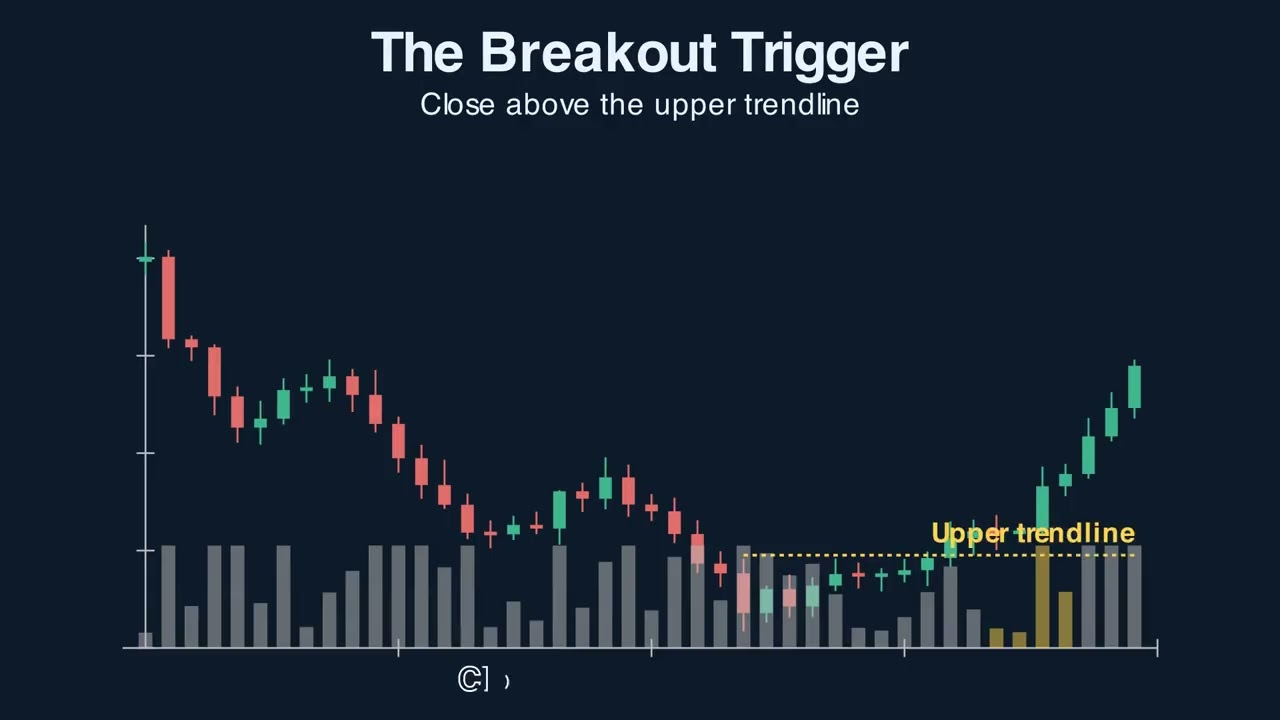
1:29Volume is the tell that makes the trade real. During the pennant itself, volume should drop sharply — visibly drier than the pole — because the move has paused and participants are watching. Then on the breakout candle, volume spikes back up to flagpole levels or higher. That's the signal that real demand has returned to push price out of the pennant. Drying volume in the pause plus a volume surge on the breakout is the exact two-step pattern you want to see.
1:58Now the trap. The pennant only works when the trendlines genuinely compress — the highs and lows converging toward an apex. A 'pennant' that's actually a wide-range sideways pause with no convergence is just a stock that ran out of buyers. Trading that as a continuation pattern gets you long right before a real distribution starts. The compression is the energy storage; without it, there's no energy to release. Measure the trendlines — if they're not pointing toward each other, walk away.
2:25On a real chart, pennants show up most often in fast-moving leadership names. The ones that worked all share the same fingerprint: a near-vertical pole of seven sessions or less, a tight compressing triangle of five to fifteen sessions on visibly drying volume, and a breakout candle that closes above the upper trendline on a clear volume surge. Train your eye to demand all three — the sharp pole, the genuine compression, and the volume confirmation — and the pennant becomes one of the cleanest, fastest setups you trade.
2:58So: a bull pennant is a sharp pole followed by a compressing triangle of converging trendlines, with volume drying through the pause and spiking on the breakout. Distinguish it from a flag — flags have parallel lines, pennants converge. Demand the compression, demand the volume, take the measured move equal to the pole's length. The pennant trades faster and harder than the flag, and respects discipline just as much. Subscribe for the full method, and trade your own plan. Education, not financial advice.