The Volume Spike Mistake Every Retail Trader Makes
TL;DR
A volume spike isn't automatically bullish or bearish — context decides. We break down the difference between climax volume (exhaustion) and continuation volume (strength), the location filter that separates them, and how pros read volume spikes correctly.
“A volume spike isn't automatically bullish or bearish — context decides. We break down the difference between climax volume (exhaustion) and continuation volume (strength), the location filter that separates them, and how pros read volume spikes correctly.”Click to post on X ▸
Where this fits in the Confluence Method
This lesson lives in the Stack step of the Confluence Method, where you confirm momentum and price action and structure before a setup qualifies as a trade.
Read the full method ▸Full transcript
7 sections0:03A volume spike at the top of an extended uptrend is exhaustion — the last buyers piling in before the trend turns. A volume spike at a clean breakout from consolidation is strength — institutional commitment to the new range. Same bar, completely opposite implications. Retail traders read every volume spike as bullish because the bar looks big and impressive. Pros read the LOCATION of the spike first, then decide. Today: the climax-versus-continuation framework that separates the two, and how to stop misreading volume.
0:37Here's the framework. Volume at extension — far above the prior range, deep into an extended move — is almost always climax: the last buyers piling in, smart money distributing into them. Volume at a breakout from consolidation is continuation: real participation marking the start of a new leg. Volume at a basing pattern is accumulation: institutions building positions quietly. Same shape of bar, four completely different meanings depending on the price-action context around it. The bar by itself tells you nothing.
1:10Watch this in a synthetic chart. Price has rallied for thirty bars — strong uptrend, extended above any reasonable moving average. A massive volume spike prints near the highs. Retail sees the big green bar and buys aggressively, treating the volume as proof of strength. Reality: that volume was distribution. Smart money used the spike to sell into retail enthusiasm. Price tops out within three bars and starts a sharp decline. Retail bought the climax bar and is now underwater. The volume was real; the interpretation was backwards.
1:45Here's the rule. When a stock is already extended — far above its prior consolidation, multiple standard deviations from its mean — a volume spike is almost always exhaustion. The big bar represents the LAST buyers, not the first. Reverse the rule for breakouts: a volume spike at the FIRST breakout from a tight base is continuation, the first wave of buyers, the trade you want. Location determines the meaning. Always.
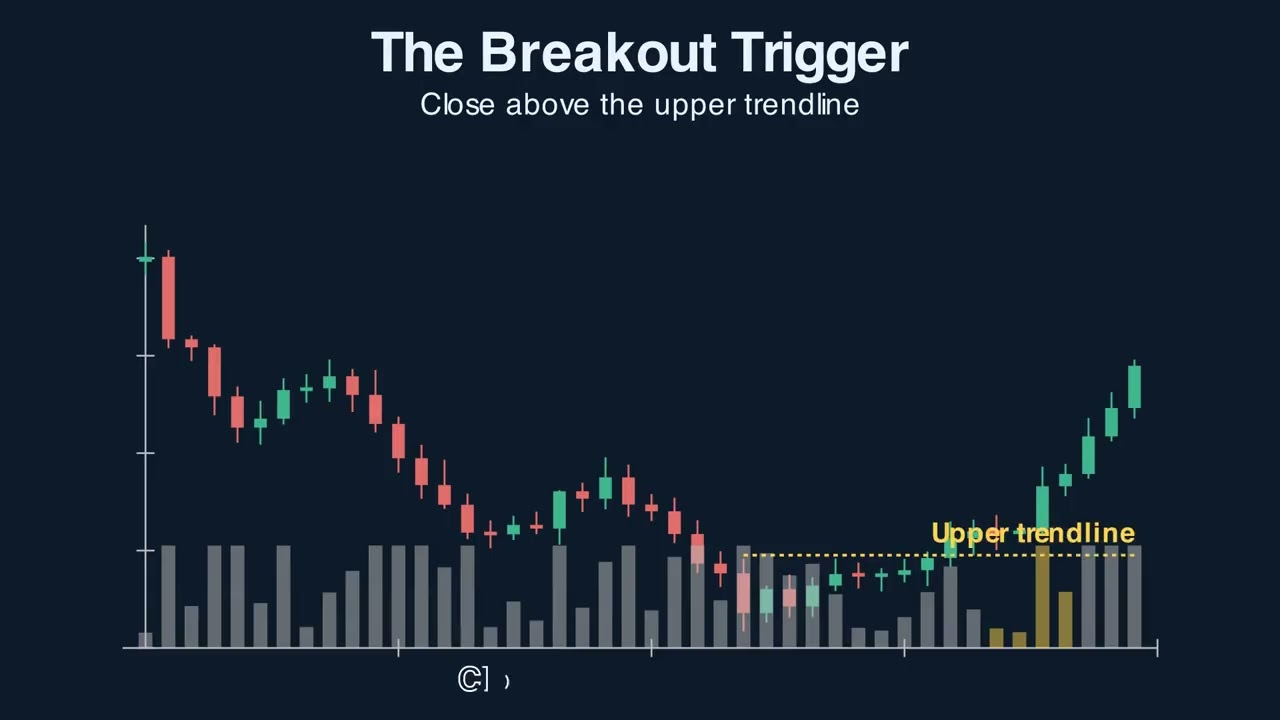
2:12Now with the correct setup. Price has consolidated tightly for twenty-five bars — quiet base, low volume. Then breakout: price clears the upper boundary of the base AND volume spikes simultaneously. THAT spike is continuation. It represents real buyers committing to the new range — the first wave, not the last. The trader enters on the breakout candle with a stop below the base, targets a multiple of the base height. This is the high-probability volume trade. Same big bar, completely different location, completely different outcome.
2:47On a real chart, the practice is to look at WHERE every notable volume bar prints before reading its meaning. A spike at the highs of an extended move? Treat with suspicion. A spike at a breakout from a tight base? High-conviction signal. A spike at the lows of a downtrend with no follow-through? Possible accumulation. The same bar tells different stories depending on where it sits. Stop reading volume as a number; start reading it as a location.
3:15So: a volume spike means strength at a breakout and exhaustion at extension. Same bar, opposite meaning. Read the location before the size. The retail trader sees a big green bar and buys; the pro sees WHERE the bar is and decides. Build the location-first habit and your volume-based reads improve immediately. Subscribe for the full method, and trade your own plan. Education, not financial advice.